
Why must Indians adjust their time-tested system because of what the West needs, asks Sanjeev Nayyar.

'President Kalam pitched his dreams high. He will be best remembered for that feat.'

'Not only the poor in India want sons, but even in the Indian community in the US and Canada. The more educated they are, the more access they have to money and use of technology in gender choice.'

A summary of sports events and persons who made news on Friday

'Tagore repeatedly denounced the "My country, right or wrong" attitude.' 'We often use the phrase "unity in diversity" like a cliche and often make diversity secondary, giving precedence to unity.' 'You do not have to shout from the rooftops that we are very tolerant.'
The Congress has ruled India for 54 of the last 67 years; that it took the party over six decades to come up with bills that provide citizens their basic needs is a shame, not a moment of triumph, says Amberish K Diwanji.

Aman Garg, 17 Devansh Kaushik, 17 and Anmol Gupta, 18 share their success journey.

'Younger children don't really distinguish based on class, gender, income and so on.'

AG Mukul Rohatgi led the Indian delegation at the UN Human Rights Council.
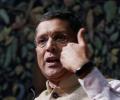
Subramanian was the Dennis Weatherstone Senior Fellow at the Peterson Institute for International Economics and Senior Fellow at the Centre for Global Development in the US before joining the ministry.

During Vajpayee's tenure, he was there as an indispensable insider, witness to every action that had an impact on history: Pokhran-II (nuclear tests in 1998), the 1999 Kargil conflict between India and Pakistan, the Indo-Pak Agra Summit in 2001, intense engagement with the United States on nuclear issues besides the Kandahar hijack.
'Now is the time for India to course correct and for the government also to course correct,' says businessman Mangesh Khatri.

'Gandhi turned his life into a counter-intuitive experiment in old ideas like non-violence and swadeshi.' 'He offered numerous universal ideas that talk to the human condition.' 'His ability to take risks was outstanding,' says Sopan Joshi, explaining why the Mahatma's ideas are as relevant as ever.
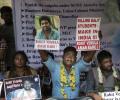
'The corporate world and the private sector economy take notice of the monstrous and apartheid like division that exists in our offices. The jobs we so casually take for granted in the upper class have come to us on the back of denial to others,' says Aakar Patel.
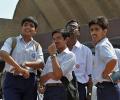
What gets forgotten in the German vs Sanskrit debate is the poor standard of teaching in India.

Shah said the Anti-Citizenship Amendment Act protests in the national capital were turned into communal riots. "I call upon my Muslim brothers and sisters that false propaganda is being spread on the issue of CAA. This Act is not to take anyone's citizenship but to give citizenship," said Shah.
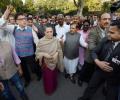
Voters deserve one. Democracy requires one. We need an alternative that people want, not just an anti-vote, says Mitali Saran.

'Their brave resistance keep our hopes alive that this youth upsurge is strengthening India's democracy and pluralism,' states Mohammad Sajjad.

'And so, despite demonetisation, people in business feel safe with Mr Modi,' points out T N Ninan.

A coalition of over 150 US-based academicians back Prime Minister Narendra Modi's visit to Silicon Valley next week and counter refute 130 US-based South Asian academics who oppose the Modi visit and his Digital India initiative.

Kagiso Rabada considers himself 'blessed' to have been a part of the 'Born-Free generation' with parents, who endured tough times to create a level-playing field for him.

To cut interest rates, the central bank head has to open up a debate on inflation target revision.
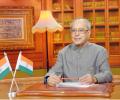
'If the institutions of democracy are under pressure, it is time for serious thinking by the people and their parties. The correctives must come from within.'

The unemployment situation is becoming increasingly acute.
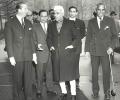
'Rightly or wrongly, 1962 got ascribed to Krishna Menon and him alone. That's unfair.' 'Certainly, he was one of the guilty men, but he was not the only guilty man. Mistakes were made all around.'

India is free, certainly, and has been so for 70 years. But are Indians free-spirited? asks Shreekant Sambrani.

After a 6.5-hour debate, the upper house clears the bill. Amit Shah said the bill is not anti-Muslim and Indian minorities have nothing to fear from its passage.

Kavitha Kuruganti has been fighting for decades to ensure farmers are respected and get their due from the Indian nation. In order to ensure they don't struggle for a living, she works to ensure sustainable farm livelihoods and farmers' rights.
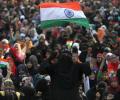
It is this new Muslim who is not burdened by the Pakistan guilt, who is ready to fight it out for the rights enshrined under the Constitution, and who is not defensive about Muslim identity that the BJP and the Sangh Parivar are out to crush, argues Mohd Asim.

Anjuli Bhargava explains why so many young Indians are packing their bags to study abroad and the steps that need to be taken to stem this outflow.

'For the likes of Zomato or Swiggy or Foodpanda or similar others, the customer has been sensitised for all times to the perils of the food pack being pilfered.' 'An important matter of trust has been exposed. And that really has been the biggest downer of this entire episode,' points out marketing guru Sandeep Goyal.
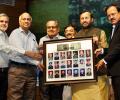
At a time when nationalism is a much-debated topic and the Armed forces' sacrifices are being ignored, a 'Wall of Heroes' at schools and colleges across the country to inspire the youth is a must, says Tarun Vijay.
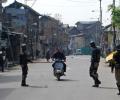
'Kashmir belongs to us all, even if we differ with each other.' 'Statesmanship demands that we sit together and let the left, right and centre of the political spectrum converge on the solution,' says former MP Tarun Vijay.
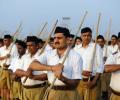
Devanik Saha wonders if saffronisation of India is on the rise

'(Upper caste) leaders talk against the Constitution, reservations and the nation and still get away.'
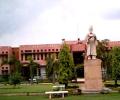
Attorney General Mukul Rohatgi's stand that AMU is not a minority university reveals the anti-minority stand of the political party now in power, says Mohammad Sajjad, outlining the long history behind one of India's premier universities.

Union Home Minister Amit Shah on Monday said the government has no other option but to extend President's Rule in Jammu and Kashmir as the Election Commission wants to hold assembly elections in the state by the end of 2019.

Questioning the bullet train in view of the investment needed in Indian Railways is similar to saying that India needed to invest in primary education rather than in IITs, says Shreekant Sambrani.
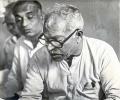
'Karpoori Thakur must be remembered by people today who are tired of witnessing fractious politics where corruption, bigotry, hatred and violence seems to have become distressingly recurrent,' says Mohammad Sajjad.

Shashi Tharoor, an alumnus of the college and Member of Parliament, talks to Ritika Bhatia about the marking system that leads to such anomalies as well as the future of higher education in the country.
